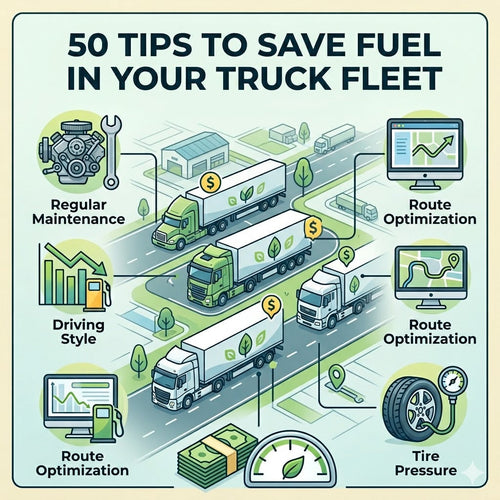
50 tips to save fuel in your truck fleet
- on June 11, 2026
- Categories: News
🔧 1. Mechanical and Preventive Maintenance
The truck's mechanical condition is the foundation of fuel economy. An efficient engine burns significantly less fuel.
-
Maintain correct tire pressure: Driving on underinflated tires increases rolling resistance and can boost fuel consumption by up to 3%.
-
Proper axle alignment: If the wheels aren't perfectly aligned, the engine has to work harder to push the truck forward.
-
Change air filters on time: A clogged filter restricts airflow to the engine, leading to poor combustion.
-
Use the right engine oil: Stick to the manufacturer-recommended viscosity; low-friction synthetic oils help improve fuel economy.
-
Check the fuel injection system: Dirty or worn injectors spray diesel inefficiently, wasting energy.
-
Brake system maintenance: Ensure that your brakes are not dragging or subtly rubbing against the drums or rotors.
-
Monitor turbocharger health: A failing turbo reduces engine power, forcing you to step harder on the gas pedal.
-
Inspect the exhaust and DPF system: A clogged Diesel Particulate Filter (DPF) creates backpressure and spikes fuel consumption.
-
Use high-quality coolant: Keeping the engine at its optimal operating temperature prevents it from overworking.
-
Check wheel bearings: Worn wheel bearings create unnecessary friction and drag.
💨 2. Aerodynamics
At highway speeds, most of the engine's energy is spent cutting through wind resistance.
-
Install roof fairings/deflectors: They channel the airflow smoothly over the top of the trailer instead of letting it slam against the front face.
-
Use trailer side skirts: These reduce wind turbulence underneath the trailer.
-
Install cab extenders: They close the air gap between the back of the tractor cab and the front of the trailer.
-
Minimize the tractor-to-trailer gap: Slide the fifth wheel as far forward as possible (within legal axle weight limits) to prevent air turbulence in that space.
-
Use aerodynamic bumper valances: They efficiently guide the airflow around the front steering tires.
-
Add trailer tails (rear deflectors): These reduce the vacuum drag and aerodynamic pull created at the flat back end of the trailer.
-
Keep windows rolled up on the highway: Driving with open windows at high speeds disrupts the truck's aerodynamics.
-
Keep tarps tightly secured: If you pull a flatbed, ensure your tarps are fully stretched and tied down; loose tarps act like parachutes.
🚛 3. Fuel-Efficient Driving Habits
The driver's right foot is the single most influential component regarding fuel economy.
-
Avoid prolonged idling: Shut off the engine if you are going to be parked for more than 5 minutes. Idling burns between 0.8 and 1.5 gallons of fuel per hour.
-
Manage your speed: Dropping your speed from 65 mph to 60 mph (or 100 km/h to 90 km/h) can improve fuel efficiency by up to 10%.
-
Use cruise control: On flat terrain, cruise control maintains a steady speed much more efficiently than human footwork.
-
Practice progressive shifting: Don't floor the accelerator during takeoff; smoothly step through the gears.
-
Anticipate traffic (Predictive driving): Ease off the throttle early if you see a red light, an exit, or slowing traffic ahead.
-
Maintain a safe following distance: Avoid the "accordion effect" (constant braking and accelerating) by keeping plenty of space ahead.
-
Drive in the tachometer's "sweet spot": Operate the truck within its most efficient RPM range (typically between 1,100 and 1,500 RPM, depending on the engine).
-
Use the engine brake wisely: It helps you slow down safely without wasting thermal energy on your service brakes.
-
Avoid hard braking: Every time you slam on the brakes, you waste the kinetic energy it took fuel to generate.
-
Conquer hills smartly: Don't try to maintain top speed on a steep climb; allow the truck to drop a little speed naturally in the right gear.
-
Leverage downhill momentum: Let gravity work in your favor on descents to safely build momentum before the next upgrade.
📦 4. Load Management and Logistics
Planning how and where you haul makes a massive difference over time.
-
Distribute weight properly: Poor cargo weight distribution negatively affects traction and increases rolling resistance.
-
Plan routes in advance: Avoid heavy traffic zones, unnecessary detours, or overly mountainous terrain when flatter routes are available.
-
Minimize empty miles: Coordinate backhauls effectively to maximize the revenue and efficiency of every single gallon spent.
-
Ditch unnecessary weight: Remove old tools, heavy chains, or spare parts you don't need from the cab or toolboxes.
-
Consolidate shipments: Group deliveries together to minimize the number of stop-and-go cycles for the engine.
-
Travel during off-peak hours: Avoid rush hour in major metropolitan areas to dodge stop-and-go gridlock.
⚡ 5. Fuel, Additives, and Specialized Tires
What goes into your tank and what touches the pavement directly impacts your bottom line.
-
Buy high-quality diesel: Clean fuel with a high cetane rating guarantees better, cleaner combustion.
-
Use fuel additives: Injector cleaners and fuel conditioners keep the system operating at peak efficiency.
-
Opt for low-rolling-resistance tires: Look for SmartWay-verified tires designed specifically to save fuel over long hauls.
-
Consider "Super Single" tires: Replacing dual tires with a single wide-base tire cuts down on total vehicle weight and rolling resistance.
-
Don't mix tire brands or tread designs on the same axle: Height and grip mismatches create subtle dragging that hurts fuel mileage.
-
Choose high-volume truck stops: Fueling at busy stations ensures you are getting fresh diesel free of moisture and contaminants.
📊 6. Technology and Auxiliary Accessories
Modern technology offers excellent tools to handle comfort and logistics without burning main engine fuel.
-
Install an APU (Auxiliary Power Unit): It provides AC, heat, and electricity to the sleeper berth during rest breaks while using a fraction of the fuel an idling main engine would.
-
Use programmable block heaters: These make cold winter starts much easier, eliminating the need to warm up the truck via long idle times.
-
Monitor truck telematics: Use ECM data reports to track your driving habits, idle percentages, and identify exactly where fuel is being wasted.
-
Install automatic tire inflation systems: These systems keep trailer tires continuously inflated to the perfect PSI while rolling down the road.
-
Use truck-specific GPS routing: Avoid low bridges or tight turns that force you into sudden stops and fuel-wasting turnarounds.
-
Optimize cab AC usage: Use air conditioning moderately, or utilize natural ventilation when weather permits during lower-speed driving.
-
Leverage automated manual transmissions (AMTs): If your truck has one, keeping it in "Eco Mode" ensures the computer selects the perfect gear shift point for maximum efficiency.
-
Check the engine fan clutch: Ensure your fan clutch cycles correctly. If it stays locked up and spins constantly, it robs the engine of significant horsepower and fuel.
-
Set up automatic engine shutdown timers: Program the truck’s computer to automatically shut down the engine after 3 to 5 minutes of stationary idling.
About Author